PokerPilot • Concept 2023
PokercoachingwithAI
Role
Product ManagerProduct DesignerEngineer
Timeline
May - August 2023
Team
2 Engineers1 Designer
Skills
Product StrategyProduct DesignPrototypingUser Research
Overview
What if AI could provide personalised coaching to new and improving poker players?
New and improving poker players lack a convenient, low-cost way to improve their game. This gap in beginner-friendly, intuitive poker coaching became the starting point for PokerPilot.
Solution
PokerPilot: AI-powered coaching for smarter poker decisions.
Configure game formation with an intuitive modal
Configure game formation with an intuitive modal
Ask poker questions and receive structured coaching
Ask poker questions and receive structured coaching
Enter hand history with a guided template
Enter hand history with a guided template
Initial Observations
New and improving poker players lack affordable, accessible support as they learn.
Poker solvers are difficult to interpret and often rely on coaches or experienced players to turn outputs into useful insights. Through early discovery with new and improving poker players, we uncovered two key pain points:
Pain Points
Solvers are hard to interpret
Poker solvers usually require coaches or experienced players to turn outputs into useful insights.
2. Coaching is not accessible
Poker coaching is expensive and generally not accessible or convenient.
Key Insight: Some players had begun using ChatGPT as an informal poker coach — for hand analysis, pot odds, and strategy feedback.
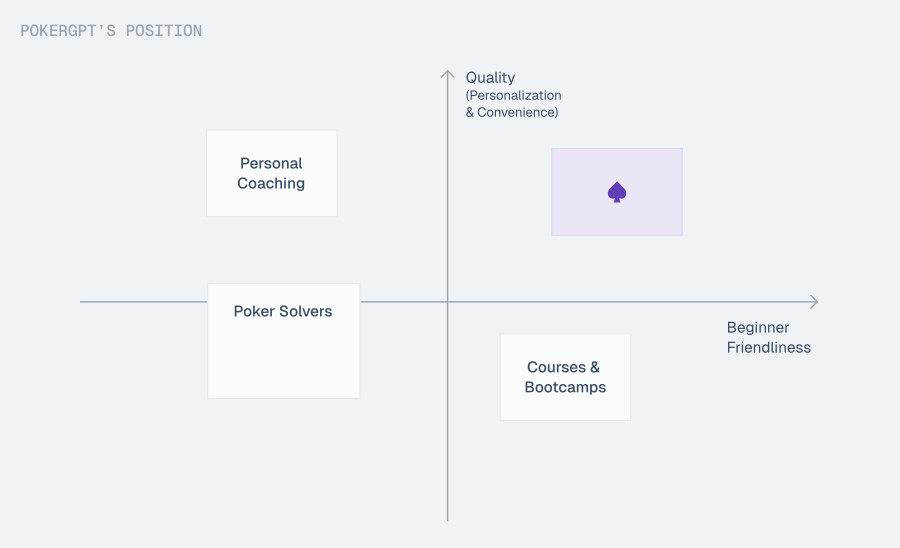
These pain points aligned with what we already saw in the market: complex poker solvers, time-intensive courses and bootcamps, and expensive coaching. User insights helped validate PokerPilot's position and showed how large language models could make poker learning more accessible.
Market Research
Poker Solvers
Platforms like GTO Wizard, Deepsolver, and Ruse AI provide access to advanced hand analysis, pot odds, and Game Theory Optimal strategies. While powerful, they still require a solid understanding of poker theory to interpret and apply effectively, making them less suitable for new and improving players.
Courses & Bootcamps
Poker bootcamps and online courses offer structured learning for players at different stages of their poker journey. However, they can be expensive and time-intensive, which often makes them less suitable for new and improving players.
Personal Coaching
One-on-one poker coaching can be highly effective, but it requires a significant investment of both time and money. Players need to commit to sessions, homework, and study, while coaching can often cost hundreds of dollars per hour — pricing it out of reach for new and improving players.
How might we make poker learning intuitive, affordable, and personalised for new and improving players?
Competitor Research
Competitor interfaces create a high learning curve for new and improving players.
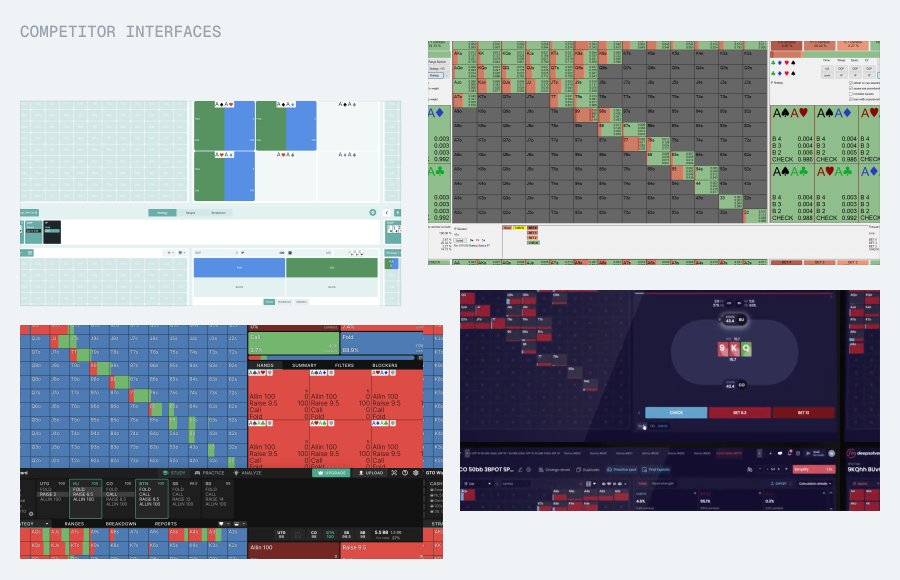
Current poker solvers are highly complex and mathematical. They work well for experienced players, but not for new and improving players looking for a more casual way to learn, improve, and understand their game.
Design Process
A chatbot built for poker players, with tailored coaching features.
Our initial user research had already validated the concept of an AI chatbot for poker coaching — but this surfaced another problem.
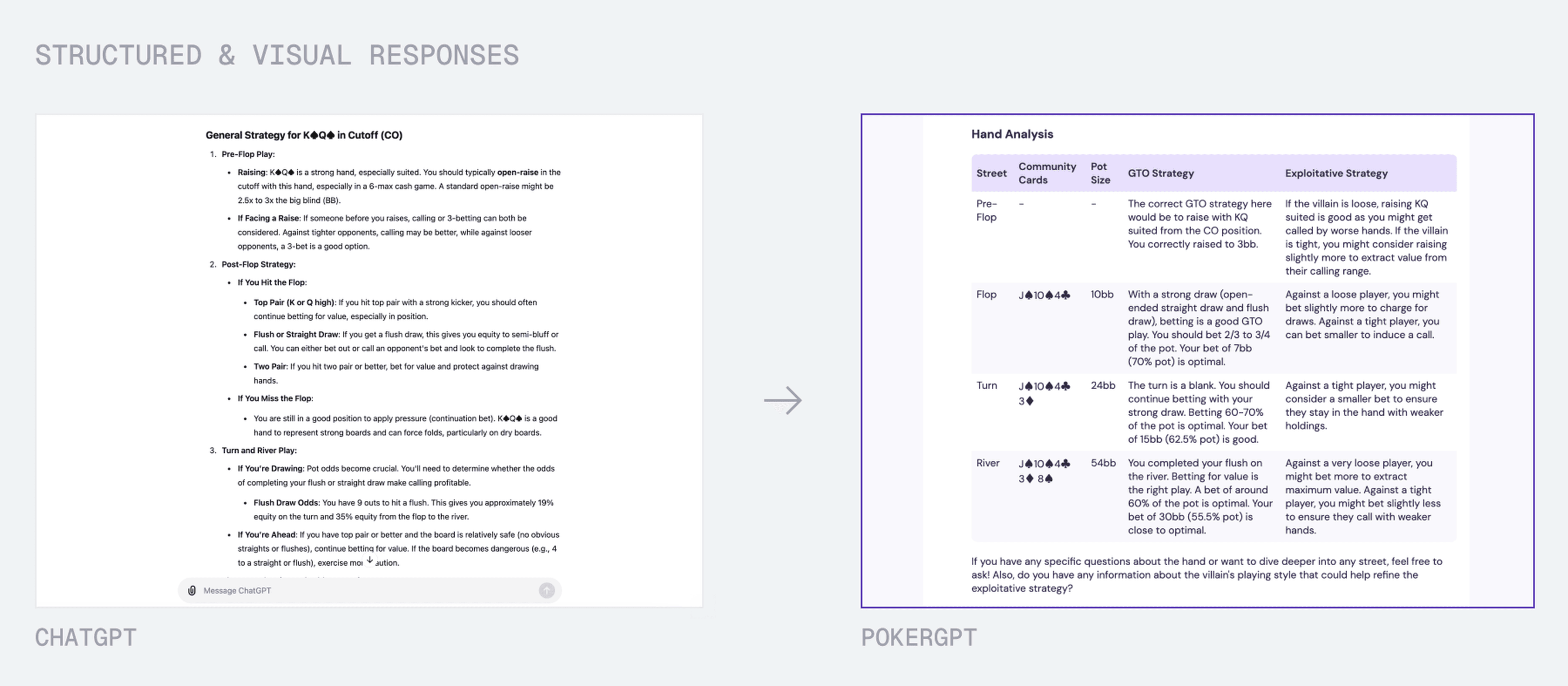
How might we design a poker learning experience better than ChatGPT?
We started by exploring how a structured, visual interface could make poker analysis easier to understand.
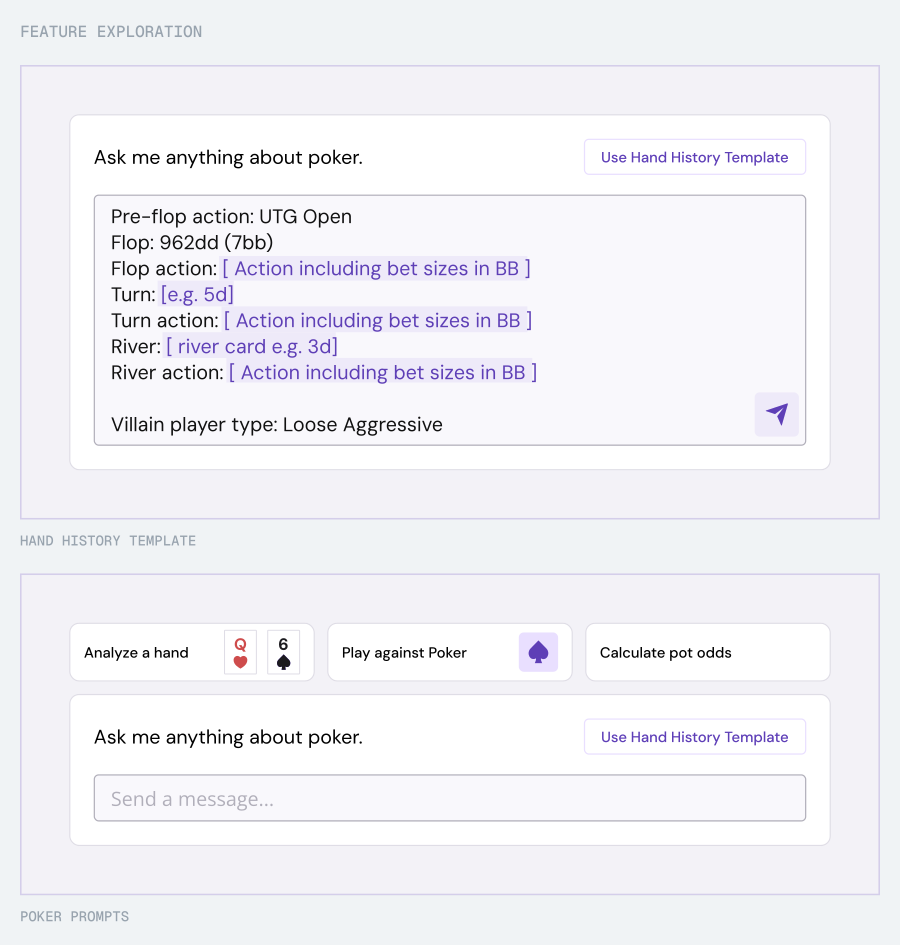
Next, we explored how to streamline prompting with a built-in hand history template, making it easier to paste past games and use suggested prompts to start the conversation.
What if we brought in game simulation?
Players were already using ChatGPT to simulate games, and poker Discord bots were gaining traction. The idea of a chatbot that could run simulations and give strategy feedback was compelling.
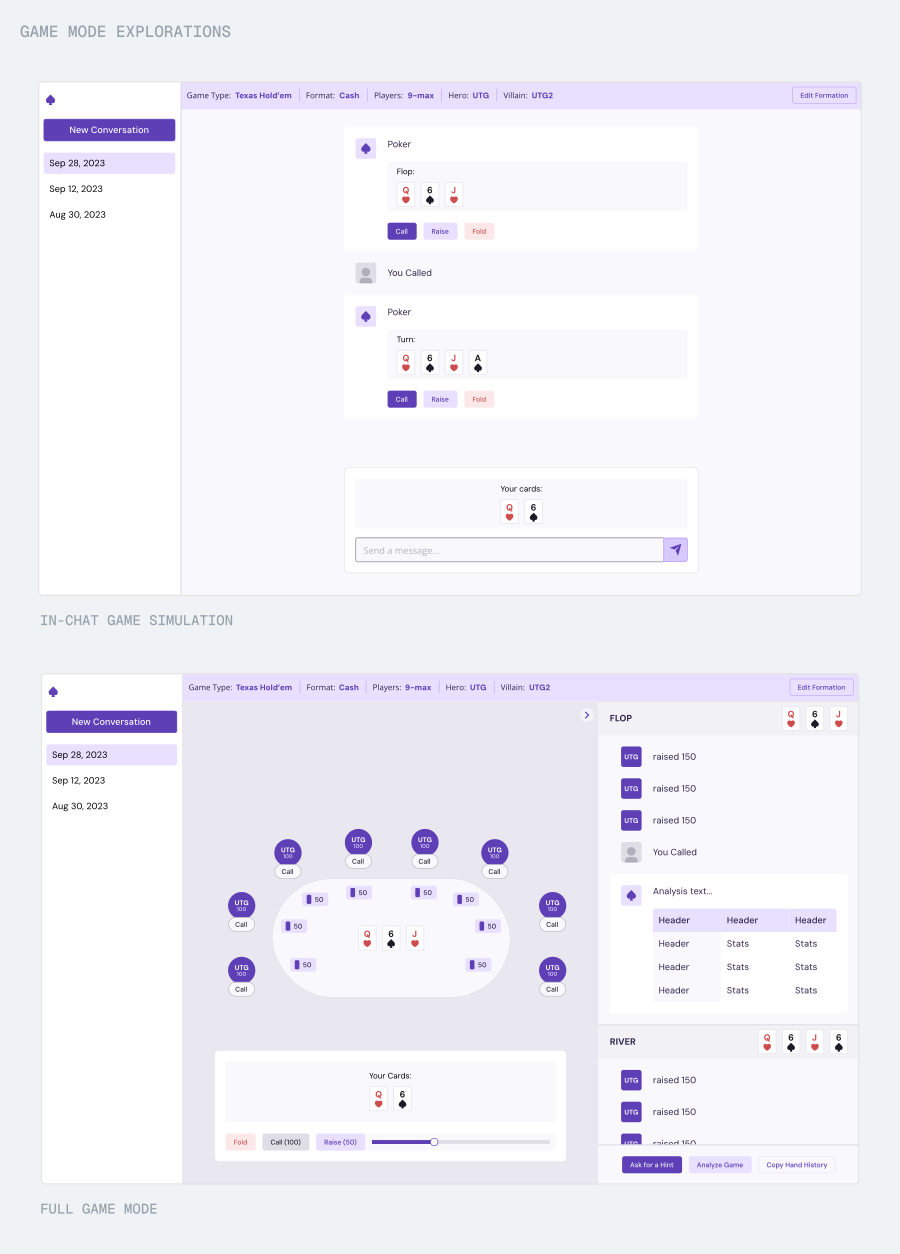
While this was a compelling direction, I prioritised the MVP, and we observed how users interacted with the open-ended chatbot. With enough usage data and confidence, we could revisit game simulation later.
Final Designs
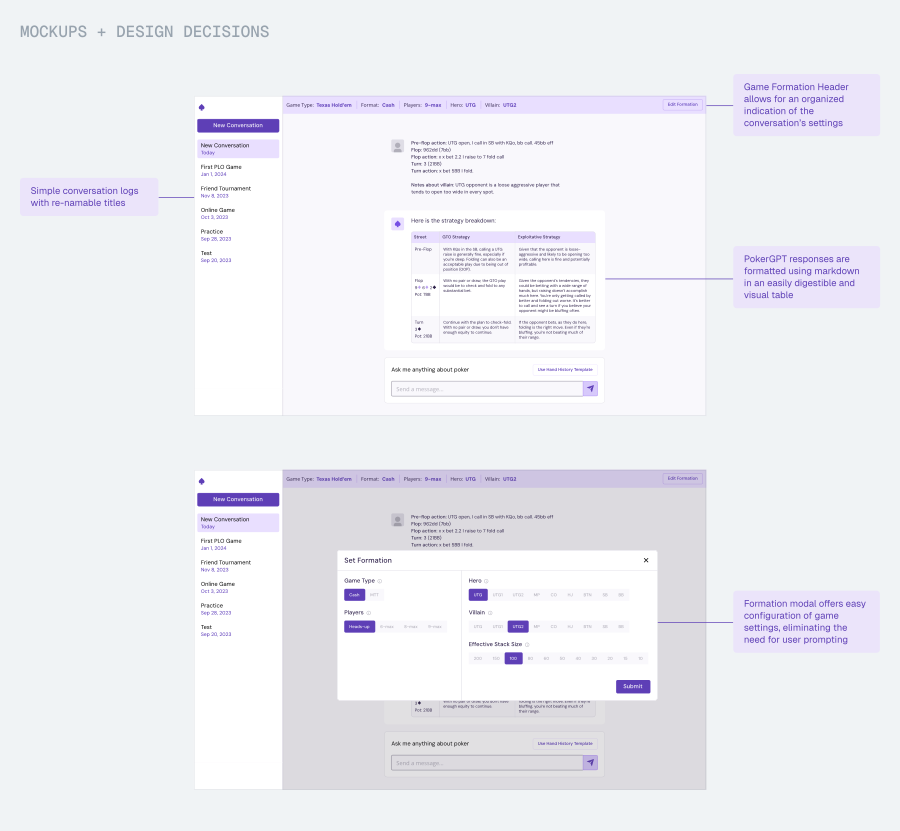
We prioritised a simple, familiar, and focused interface.
The main interface combines chat, structured responses, and configurable game formations. This creates a familiar chat-style experience with features tailored to poker analysis.
Grounded coaching, not generic advice.
PokerPilot uses structured prompting over a retrieval layer: it breaks each hand into key context — position, stack depth, board texture, decision point, likely intent — then surfaces relevant strategy material (coaching notes, glossary terms, comparable hands) and passes it to the model alongside the prompt. The result is feedback that's consistent, explainable, and grounded in real poker fundamentals.
Reflection
What I learned
Keep cutting it down to the MVP.
I stayed focused on shipping the Minimum Viable Product, which helped us move fast and gather feedback early.
User research is not enough.
Interviews and user stories only take you so far. For a niche market like poker, I had to immerse myself in the user's world to truly understand their needs.